

How Much Should a Law Firm Owner Pay Themselves?
By Darren Wurz, CFP®, founder of The Lawyer Millionaire
The short answer: pay yourself a market wage for each role you actually fill (lawyer, CEO, even admin), weighted by how your time splits. If you're half lawyer and half CEO, your wage is half of what an experienced lawyer earns plus half of what a law firm CEO earns. Pay it as a fixed monthly salary or draw and treat it like payroll. Everything the firm earns above that is profit, and profit gets paid out separately, on a schedule, after the firm's reserves are funded.
I walked through this in full on Episode 184 of the podcast. Here's the short version, and how to set your number.
Most owners answer the wrong question
When owners ask how much to pay themselves, they usually mean "how much can I take out this month?" That question has no stable answer, because law firm cash flow isn't stable. A PI firm works a case for months before it settles. A criminal defense firm collects up front, then burns the fee over the life of the case. Annual bills, like a $60,000 SEO retainer, land in a single month.
So owners take what's there. A big draw after a settlement, nothing in a lean month, and sometimes a transfer from personal savings back into operating to make payroll. On Episode 135, Charley Mann of Law Firm Alchemy and I talked about how common this is. It's one of the first problems new clients bring us.
The cost isn't only stress at home. When money flows both directions between your firm and your household, you can't save consistently, because you never know when you'll need to send $10,000 back. One of my first clients changed one thing: we set a fixed monthly draw. That was the whole fix, and it changed how his household ran.
And the numbers show how common underpaying yourself is. A Martindale-Hubbell study found solo and small-firm lawyers earned a median of $148,000 (2022 figures). NALP's 2025 survey put the median first-year associate salary at firms of 250 or fewer lawyers at $150,000. The typical owner, with years of experience and all the risk, earns about what a brand-new associate does. If you're the lowest-paid attorney in your own firm, the firm isn't growing. Your unpaid wages are funding it.
Step 1: Find your market wage
Greg Crabtree's Simple Numbers puts it bluntly: if you pay yourself well under market wage, you don't know whether your business is profitable. You're hiding a labor cost inside your "profit."
Ask one question: what would it cost to hire people to do the work I personally do? Most owners wear more than one hat, so the answer is a blend. List your roles, estimate the share of your time each takes, and price each role at market.
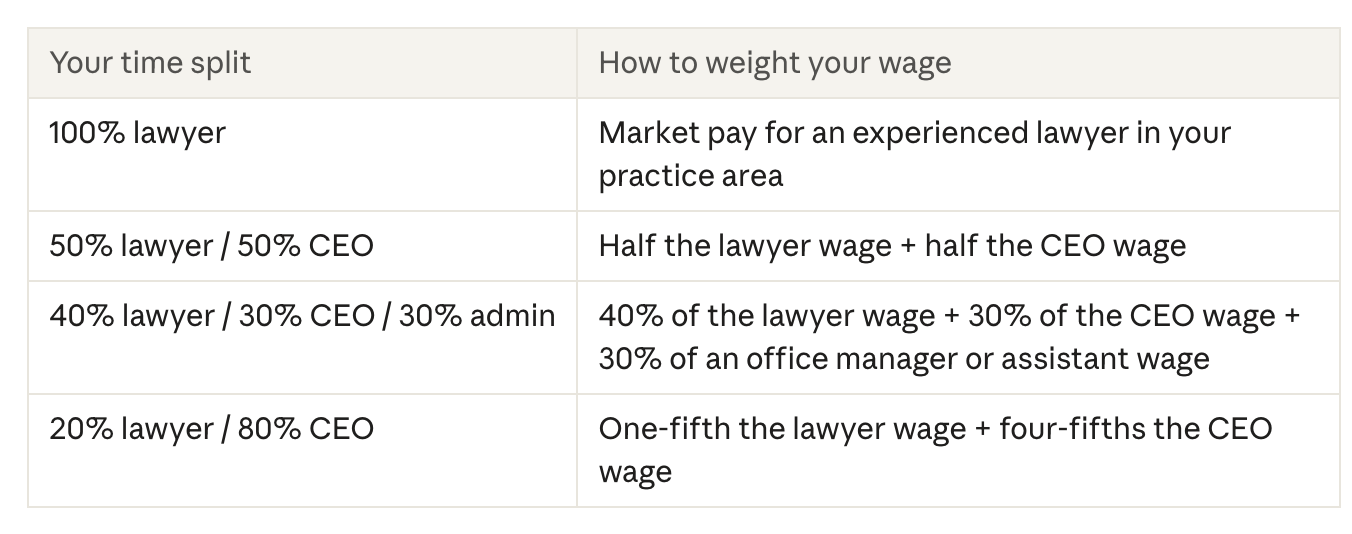
Here's the example from Episode 184: a senior associate carrying your caseload might cost $180,000, and a competent administrator doing the management work you handle on nights and weekends would cost $70,000. Your market wage is $250,000. Use salary data for each role in your practice area, firm size and market. If you're still doing admin work, price that share at what you'd pay an assistant or office manager, not at your lawyer rate. That number stings on purpose: every hour of admin you keep pulls your wage down, and it's the clearest case for your next hire. The blended number is your owner wage, and it changes as your role does. As you step out of casework, the mix shifts toward CEO.
Running the firm is a job, so it belongs in your wage. Profit is something else: the return on owning the firm, which you'd still earn if someone else did both jobs.
Step 2: Pay it the same way every month
Set the wage as a fixed monthly amount and automate the transfer, exactly like staff payroll. Whether it runs as W-2 salary through an S corporation or as a scheduled owner's draw depends on your entity and tax plan. In an S corp, only the W-2 portion carries Social Security and Medicare tax, so some owners take part of their wage as W-2 and the rest as a fixed monthly draw. The IRS requires reasonable compensation, though, so the W-2 portion has to be defensible. A reasonable compensation analysis from your CPA sets it. The principle holds either way: same amount, same day, every month.
Consistent personal income is the bridge from unpredictable firm cash flow to predictable wealth building.
Step 3: Take profit separately
Once your wage is a fixed line item, true profit becomes visible. Say your firm bills $1,000,000, overhead runs $600,000, and you take $120,000. The P&L shows $280,000 of profit, a 28% margin. Now pay yourself the $250,000 market wage instead. True profit is $150,000. That's still real profit, but it's far less than you thought, and in a smaller firm it can disappear.
Pay profit quarterly or off a rolling average, not the week a big check clears. Clients who prepay at year-end make Q4 look terrific and Q1 look terrible. A rolling 12-month view smooths it out.
If your take-home isn't meaningfully above your market wage, the diagnosis is uncomfortable. You don't own a profitable firm. You own an underpaid job with overhead.
Where this fits: The Three Conversions
Our framework, The Three Conversions, describes how a law practice becomes freedom: Practice → Profit → Capital → Freedom. Owner pay sits at the first two hinges.
A market wage is how you know the Practice-to-Profit conversion is happening at all. A fixed, predictable paycheck is what makes Profit-to-Capital possible, because you can only invest consistently out of income you can predict. Profit that stays in the firm, or gets spent as fast as it arrives, never becomes capital.
What to do in a lean month
Lean patches happen. Don't abandon your salary at the first one.
Check your history. Is this a seasonal dip or a real decline? If late summer is always slow and Q4 always recovers, ride it out.
Draw on firm reserves or a line of credit first. Avoid putting personal money back into the firm.
If the decline is real, cut expenses before you cut your pay. Less revenue usually means less work, and that usually means a staffing or overhead adjustment.
Lower your wage only as a last resort, and revisit it within a quarter.
Paying yourself less is a short-term fix. The long-term fix is a more profitable firm.
Do this—this month
Pick a fixed monthly salary or draw, set it up as an automatic transfer, and start it this month. Review it every quarter. Not sure where you stand? The Owner Pay Reality Check takes about two minutes and compares what you pay yourself with what you should.
If you want help setting your number and building the reserve that protects it, book a strategy call. We work with law firm owners on a flat fee, so we have no stake in where your money goes, only in whether it works for you.
This article is educational and is not tax or legal advice. Talk with your CPA about salary versus draw for your entity.
FAQ
How much should a law firm owner pay themselves?
A market wage for each role they fill, weighted by how their time splits. An owner who is half lawyer and half CEO pays themselves half the market wage of an experienced lawyer plus half the market wage of a law firm CEO. Time still spent on admin tasks is priced at an admin wage. Pay it as a fixed monthly salary or draw, like payroll, and take profit above that separately on a quarterly schedule.
Should I pay myself a salary or an owner's draw?
It depends on your entity. S corporation owners run a reasonable W-2 salary and take distributions on top; sole proprietors and most LLC owners take draws. Either way, make the amount fixed and the timing automatic. Your CPA should set the structure.
What if my firm can't afford my salary this month?
Check whether it's a seasonal dip or a real decline. Cover seasonal dips from firm reserves or a line of credit rather than personal savings. If the decline is real, cut expenses before cutting your pay, and lower your wage only as a last resort.
How do I know if my law firm is actually profitable?
Subtract a market wage for the roles you fill, lawyer, CEO or both, from your take-home. What's left is true profit. If your take-home isn't meaningfully above that wage, the firm isn't profitable yet; it's paying you for a job.
How often should a law firm owner take profit distributions?
Quarterly, or based on a rolling 12-month average, after the firm's reserve is funded. Paying profit out the week a large settlement or prepayment lands overstates what the firm earns and sets up a short quarter later.